
 Urban road · 2D objects & lane lines
01
Image
IMAGE
Define classes and boundaries, from object boxes to pixel-level regions.

DATA ANNOTATION
Data annotation services
Define classes, boundaries and attributes around your model task. Align the rules in a small pilot, then annotate and review each batch with supporting quality records.
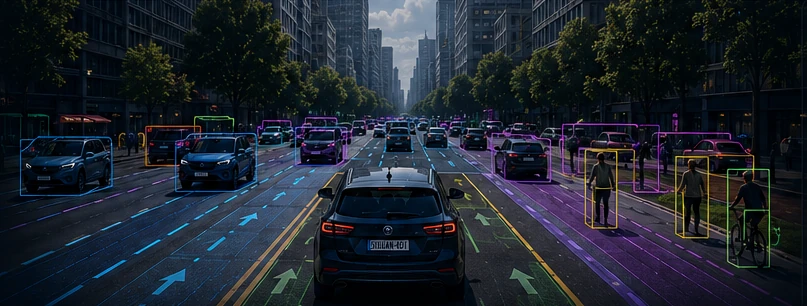
ANNOTATION VIEW
BUILT FOR TRAININGConsistent rules connect annotation, review and delivery, from class definitions to batch acceptance.
SERVICE SCOPE
From visual perception to language understanding, define task rules first, then shape a suitable annotation plan. The scope below can be adapted to the project.
IMAGE
Define classes and boundaries, from object boxes to pixel-level regions.
VIDEO
Connect consecutive frames and behavior events with stable object IDs.
POINT CLOUD
Describe spatial objects through position, dimensions and orientation.
MULTIMODAL
Connect images, point clouds and context through shared object semantics.
TEXT
Structure language tasks with entities, intent, sentiment and relations.
AUDIO
Connect sound with usable labels through transcription, speakers and timing.
ANNOTATION SAMPLES
Switch between data types to explore typical tasks, input requirements and possible delivery formats. Align field definitions and quality requirements.
IMAGE
DELIVERABLES
Agree on schemas and acceptance criteria during the pilot so each batch can be understood, checked and reused.
Classes, geometry, attributes and object IDs in the agreed structure.
Class dictionaries, attribute rules, boundary examples and change history.
Review records, issue categories, rework status and batch acceptance notes.
File indexes, count reconciliation, delivery versions and key relationships.
PROCESS & QUALITY
Each stage has a defined output. Sampling ratios, schedules and acceptance thresholds are agreed after project evaluation.
Define the model task, class boundaries, inputs and acceptance approach.
Test the rules on a small batch and align difficult or disputed cases.
Annotate in batches, review in stages, record issues and complete rework.
Check structure, coverage and agreed quality items before packaging.
CUSTOMER CASE
A road-vision team piloted 2D bounding boxes on 360 images, focusing on small objects, occlusion and truncation. Rule revisions and rechecks established consistent boundaries and issue handling.
 ROAD VISION / ANNOTATION
FAQ
Prepare the data type, model objective, estimated volume, draft classes, output format and desired schedule. A small de-identified sample can help clarify boundary cases and a pilot plan.
A pilot can be planned to validate rules, formats and quality checks. Sample size, timing and pricing depend on the complexity of the data and are set out in the project plan.
Turn broad requirements into specific checks, such as class consistency, geometric boundaries, omissions and temporal relationships. Then agree on sampling, acceptance thresholds and dispute resolution.
Adaptation can be assessed from your schema, platform requirements and de-identified samples. COCO, YOLO and KITTI are possible discussion directions; actual compatibility must be validated in a pilot.
Evaluate task complexity, volume, review requirements and delivery schedule. Access scope, retention and handover requirements should be agreed before work begins. Pricing and delivery dates follow the agreed project plan.
START WITH YOUR DATA
Share your data type, model objective and estimated volume to frame an initial pilot.


